Posts

Hello Aero-People...

Image
WEL-COME TO THE WORLD OF AERO TECHNOLOGY Hello Aero-People, I have started this blog  to share my knowledge of Aviation Technology . I hope you will enjoy it and this will be helpful to you. This blog is all about Aviation and Aero Technology. Here you find... Interesting and amazing things about Aerospace, Aviation and Aeronautics. Many questions for FAA, EASA, DGCA etc  exams.  Videos of A ircraft accident and incidence. Aviation NEWS.

Metal Earth F-15 Eagle. I love to assemble aircraft model & I have enjoyed it.

Image
Metal Earth F-15 Eagle. I love to assemble model.  I have purchased models laser-cut from a single 4" square sheet of steel.  Pop out the pieces, bend the tabs  and assemble it. Finally my model is ready to showcase. I have enjoyed it. This model depicts the McDonnell Douglas/Boeing F-15 Eagle tactical fighter,  which remains undefeated in air-to-air combat. The speedy, agile twin-engine F-15 has been in service with the U.S. Air Force since 1974.

Effect of Rain & Snow on Jet Engines...

Image
You might have some question like.... How can a jet engine work when it rains or snows? Wouldn't the water put out the flame inside? How is water removed from a jet engine in rainy conditions? Does rain or snow ingestion affect the efficiency of a jet engine? Answers are here... As we know a jet engine works by compressing incoming air,  mixing it with fuel, igniting that mixture, and exhausting the high-pressure gases to  produce thrust. The initial compression is accomplished through a series of rotating  blades called compressors. After jet fuel is added through a fuel injection system, the  mixture is burned in a combustion chamber. The exhaust moves through another series  of rotating blades called the turbine that powers the engine and finally through a nozzle. Simple Jet Engine The biggest danger posed by forms of precipitation like rain, snow, ice, or fog is an engine flame-out. A flame-out is defined as a loss of engine power that is not caused by a mec...

Canted Vertical Tails - Why are the stabilizers on planes like the F-18 and F-22 slanted?

Image
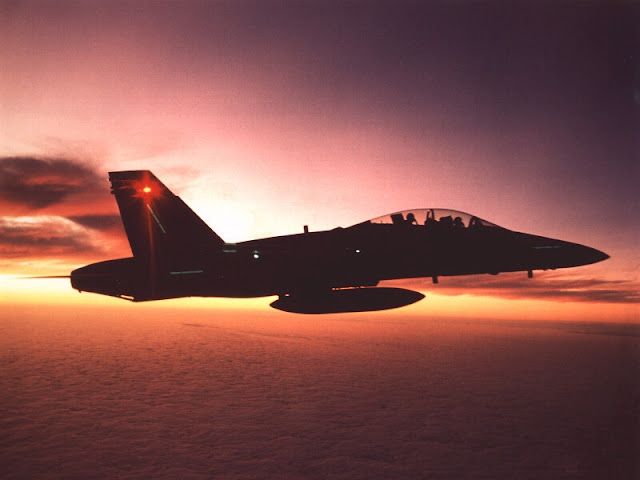
Why are the stabilizers on planes like the F-18 and F-22 slanted? The tail configuration is usually referred to as canted vertical tails, since the vertical stabilizers are canted away from being 90° straight up and down. As illustrated in the below photo of the F-18 Hornet, this design has become increasingly common on modern military aircraft. Canted vertical stabilizers on the F-18 Other well-known examples of this trend include the F-22 Raptor, F-117 Nighthawk stealth fighter, and F-35 Joint Strike Fighter. The feature traces its roots back to the 1960s when canted tails were incorporated into the SR-71 Blackbird and its predecessors, as shown below. Canted vertical stabilizers on the SR-71 Lockheed designers included these canted tails based on early research into stealth technology. As far back as the 1940s, engineers had realized that perpendicular surfaces, like vertical tails, generated strong radar returns. By canting the tails away from 90°, the radar cross-section (RCS) of ...
Hey! Why a Golf Ball Has Dimples?

Image
Why a Golf Ball Has Dimples? While few among us can deny that golf is one of the least exciting of all spectator sports, we aerospace engineers are fascinated by its aerodynamics! Even the non golfers of the world are familiar with the shape of a golf ball, like that pictured below, and have probably wondered why its surface is covered with small indentations called dimples. The dimples of a typical golf ball Before explaining the purpose of dimples, we first need to understand the aerodynamic properties of a sphere. Let us start by looking at a smooth sphere without any dimples, like a ping-pong ball. If we lived in an ideal world without any friction, the air flowing around a smooth sphere would behave like that shown in the following diagram. In this figure, the angle  represents position along the surface of the sphere. The leading edge of the sphere that first encounters the incoming airflow is at =0° while the trailing edge is at =180°. A position of =90° is the top of th...

What is Area Rule and What Aircraft were developed?

Image
What is Area Rule and What Aircraft were developed? The area rule is an important concept related to the drag on an aircraft or other body in  transonic and supersonic flight. The area rule came into being in the early 1950s when  production fighter designs began pushing ever closer to the sound barrier. Designers  had found that the drag on these aircraft increased substantially when the planes  traveled near Mach 1, a phenomenon known as the transonic drag rise illustrated  below. This increase in drag is due to the formation of shock waves over portions of the  vehicle, which typically begins around Mach 0.8, and this drag increase reaches a  maximum near Mach 1. Because of its source, this type of drag is referred to as wave  drag. Increase in wave drag at transonic Mach numbers Since the physics of supersonic flight were still largely a mystery to manufacturers,  designers had no idea how to address this problem except to provide their a...

Aircraft Landing Gear

Image
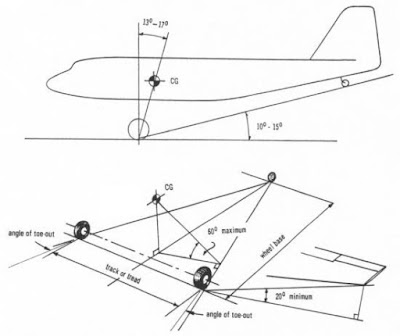
Why do aircraft have only three landing gear? Why not four? Most aircraft today have three landing gear. Two main landing gear struts located near the middle of the aircraft usually support about 90% of the plane's weight while a smaller nose strut supports the rest. This layout is most often referred to as the "tricycle" landing gear arrangement. However, there are numerous other designs that have also been used over the years, and each has its own advantages and disadvantages. Let's take a closer look at the various undercarriage options available to engineers. Tail-wheel or Tail-dragger :  Gear Though the tricycle arrangement may be most popular today, that was not always the case. The tail-wheel undercarriage dominated aircraft design for the first four decades of flight and is still widely used on many small piston-engine planes. The tail-dragger arrangement consists of two main gear units located near the center of gravity (CG) that support the majority of the p...